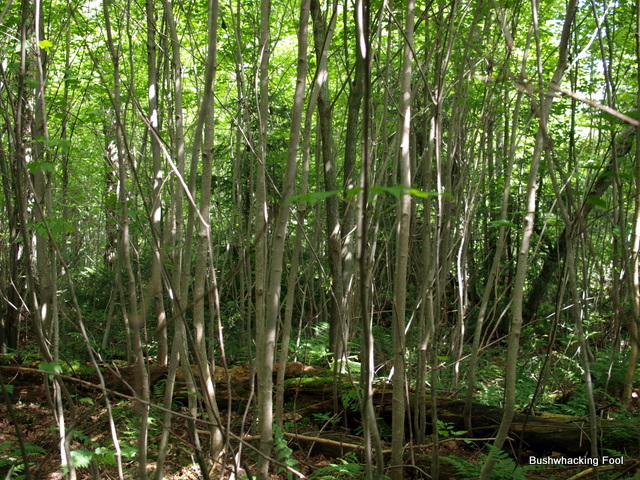
Regenerating blow down
The following is a description of an eight-day bushwhacking adventure into some of the most remote areas within the Five Ponds Wilderness in the northwestern Adirondacks. The trip includes traversing areas of intense blow down along the oddly-shaped Oven Lake, exploring a cluster of wilderness ponds and following along the wild Robinson River. The first part of the fourth day is an ardous struggle through blow downs along the western shore of Oven Lake.
Section Stats:
Date: July 1, 2011
Length: 0.8 miles (0.8 miles for the day)
Difficulty: Difficult
A morning chorus of birds welcomes me to a new day around dawn at Oven Lake. Although I slept well, I was in no hurry to struggle through the regenerating blow down along the lake shore. Instead I lie in my sleeping bag and listen to the delightful songs of a wide variety of Adirondack birds. Northern waterthrush, white-throated sparrow, brown creeper, hermit thrush and red-winged blackbird are just a few of the species singing within the vicinity of my campsite on Oven Lake.
View Day Four Part One in a larger map
Mixed in with the cacophony of bird songs are several frogs continuing their calls from the previous night. Apparently, several green and mink frogs had an unsuccessful night of love-making and were now looking for some early morning delight. Making camp too close to the shore has its downside when it comes to the horny frogs calling out their desire at all hours of the night. This seems to be one of those lessons that I must learn over and over again.
Hear the morning chorus of birds and frogs at Oven Lake. Note: it may be necessary to turn up the volume since the levels were set low unintentionally.
Despite the clear skies during the night, the early morning sky is socked in with clouds. And last I knew the weather forecast for today was for clear skies and high temperatures. I am completely willing to forgo with the high temperatures but seeing the sun occasionally today would be appreciated.
The cloudy sky made me thankful I decided to head directly toward Cracker Pond rather than make the long journey around Oven Lake and its neighbors to the south. The blow down visible along the eastern shore of the lake appears to be quite formable from my position along the western shore. Avoiding a couple days of fighting through the blow down and its dense regeneration will ensure I retain my original schedule from today forward. Not visiting every place on my itinerary gives me a good reason to return at some future point to explore Grassy and Hitchins Ponds.
My revised plan for today is to camp at the northern end of Oven Lake. The distance between my current location and today’s final destination is approximately one mile as the crow flies. Even with the extensive amount of blow down, I expect this to be a reasonable goal. The singular hurdle, other than the blow downs, is the outlet stream from the lake. The outlet is very wide at its mouth where it leaves the lake and this may force me to journey a significant distance upstream before crossing.
While gorging myself on an excessive amount of oatmeal, I observe a female red-winged blackbird moving around in the shrubbery along shore. I notice she is repeatedly catching dragonflies and then flying down to the same location along shore. When I creep closer to her destination, I finally see her feeding a young fledgling perched within the shrubs. I watch the young fledgling enjoy its breakfast as I continue to enjoy mine.
With breakfast finally over, I pack up all my equipment and prepare to bushwhack to the northeast along Oven Lake’s shore. My plan is to follow along the shoreline as much as possible while occasionally cutting through the forest to avoid some of the peninsulas created by the undulating shoreline.
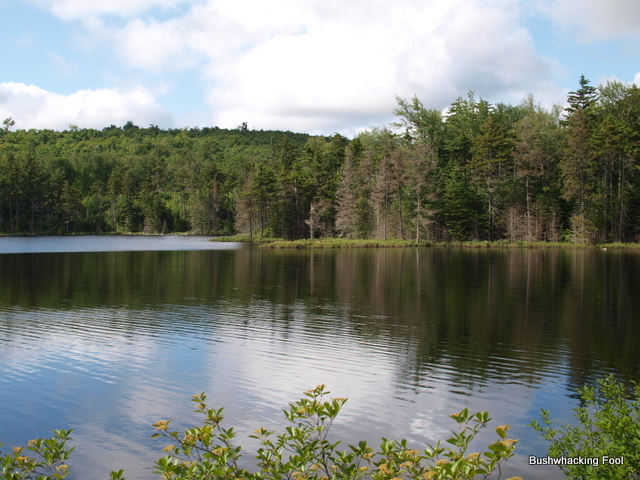
Lower Oven Lake
My original plan included exploring the large peninsula separating the southern portion from the rest of the lake but nature’s call forced me far from the shoreline. By the time I struggled my way through the regenerating forest to find an adequate place to take care of my business (point #36 just in case you want to check it out) I start to have second thoughts about my next move. When I am finally finished and can think clearly again, I decide not to retrace my path down the peninsula and instead head northeast to its far side. Exploring the peninsula will just have to wait until my next trip to Oven Lake.
The going through the forest along the west shore of Oven Lake is extremely slow. I continuously weave through the near 100% blow down, often pushing myself through the dense regenerating hardwood saplings surrounding the downed trees. The sapling stems continuously grab at my backpack as well as my pants, jacket and especially my hat. Why do they always go for my hat? The lack of light due to the dense canopy just a couple feet above my head makes it appear much later in the day. In addition to the downed trees and the regenerating saplings, the rolling terrain, with frequent rocky outcroppings to detour around, make the going extremely difficult.
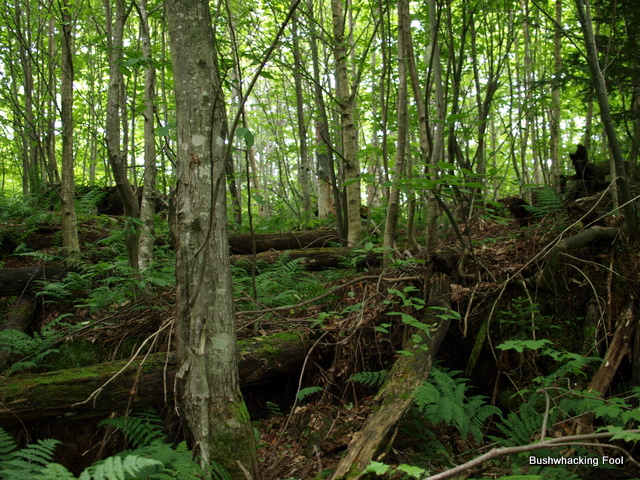
Blow down along west shore of Oven Lake
Once I reach the northern side of the large peninsula (point #37), I change my heading to the west to make my way around a slender bay of Oven Lake (point #38). After getting around the bay, I am able to resume my northeastern bearing while attempting to remain within sight of the lake.
Following close to the lake’s shore works out rather well for a while. Although sometimes I cannot see the lake through the dense growth, I am able to keep a sense for where it is located. I return to the shoreline briefly from time to time for some photography opportunities (e.g. point #39).
After taking some photographs of the central portion of Oven Lake, I change my bearing to the north to cut off some of the shoreline along a broad peninsula. While cutting across this peninsula, I bushwhack through a grove of large eastern hemlocks (point #40). These gigantic trees were fortunate enough to avoid the full onslaught of the 1995 Microburst (or tough enough to endure it). If not for the slight slope this would be an ideal place of a campsite. I side-step several piles of moose droppings here; apparently the moose agree with my assessment of the site’s potential – at least for a restroom.
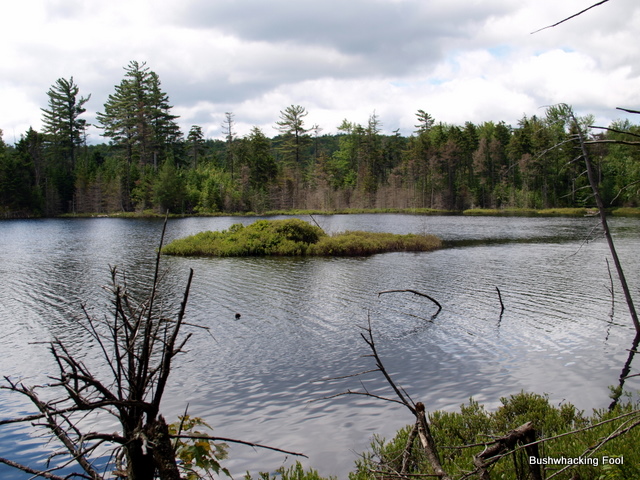
Small island in middle portion of Oven Lake
With another bay of the lake behind me I attempt to stay at the sweet spot between the blow downs to the west and the remnant mature softwoods near the shore. Although thick with some hardwood saplings from the infusion of light from the blow downs, there are fewer downed logs to detour around or crawl over. Navigation is a challenge here and I tend to drift farther away from the shoreline until the lake is no longer visible through the forest (point #41). I concentrate on returning to the vicinity of the shoreline before changing my bearing to the north (point #42).
A mature forest is present all along much of the shore in this area. Like the hemlock grove earlier, the forest here must have been sheltered from the worst of the 1995 Microburst. In addition to the scattered hemlocks, there are large yellow birches, balsam fir and red spruce. Underneath the towering trees in the upper canopy there is a thick understory of regenerating hardwoods beneath. These younger hardwoods were obviously stimulated by the infusion of light from the blow downs to the west. Scattered about are the stumps of many young trees; those that fell prey to a local beaver, their sharpened points acting as possible deadly hazards.
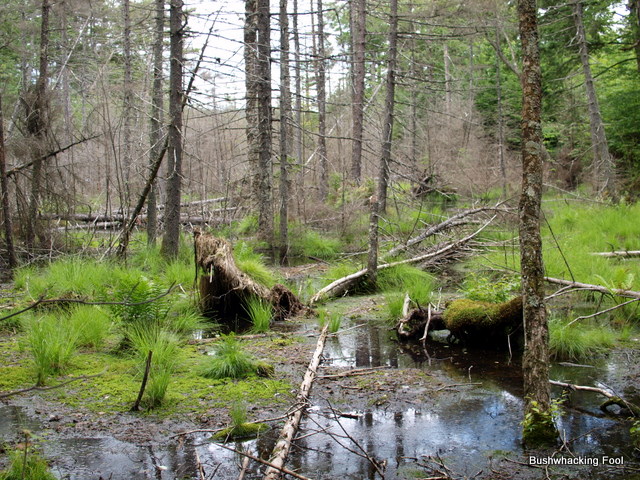
Beaver-created swamp
Soon any further progress to the northeast is stymied by a snag-infested swamp. I head west along the edge of the swamp to detour around it before returning to the lake. There is less evidence of blow down as I make my way around the western edge of the swamp. I stop briefly to watch a northern waterthrush feed a fledgling near the swamps edge.
A description of a more significant detours necessitated by beaver flooding at the outlet of Oven Lake will be the subject of my next post. Be on the lookout for this next chapter later this week.
Affiliate Disclaimer: Some links within this blog post may send you to a retailer website. If you chose to purchase any product at that site at that time the author will receive a small commission. These commissions provide compensation for the author’s time and effort necessary to provide the amazing content at the Bushwhacking Fool.


