
Eastern view of West Pond
The following is a description of an eight-day bushwhacking adventure into some of the most remote areas within the Five Ponds Wilderness in the northwestern Adirondacks. The trip includes traversing areas of intense blowdown along the oddly-shaped Oven Lake, exploring a cluster of wilderness ponds and following the wild Robinson River. The third part of day six is a short bushwhack between Gal and West Ponds.
Section Stats:
Date: July 3, 2011
Length: 0.4 miles (1.7 miles for the day)
Difficulty: Moderate
With the trip around Gal Pond complete, a lunch break was sorely needed before completing the day’s bushwhack to West Pond. My current location with its attractive view of Gal Pond was an ideal spot, so I shed my backpack and pull out my food with the notion of lightening my load by one lunch foremost on my mind.
View Day Six, Part Three in a larger map
While eating lunch near the shore of Gal Pond, the dark overcast starts to break apart and large patches of blue sky appear. The sunshine is definitely welcome but the accompanying higher temperatures combined with the already high humidity completely undo all the personal hygiene and laundry work I performed the previous day at Cracker Pond.
After finishing lunch, I depart from Gal Pond by heading southwest toward its nearest neighbor: West Pond. The forest between the two is strikingly similar to the mature forest along Gal’s northwestern shore. Many large hemlocks highlight this area as do the occasional blow downed trees.
I complete the distance between the two ponds quickly as I grow increasingly weary and anticipate the lounging around to commence immediately after setting up camp for the day. Although the day’s hike was not very lengthy, the weight of the threatening skies combined with the high humidity and frequent backtracking has left its toll and I was ready to relax for the remainder of the afternoon.
I notice several piles of moose scat between the two ponds. How can I not have seen one of these large ruminants by now? Where could they possibly be hiding? Are Adirondack moose really timid? With only two more days left, my opportunities for spotting one are rapidly decreasing.
Upon reaching West Pond at its eastern most point, I shed my Golite Pinnacle backpack and rest for a while before searching for a campsite for the night. Since I plan on departing along the western shoulder of Greenfield Mountain toward the Robinson River tomorrow morning, I want to position myself the farthest west along the pond’s northern shore as possible. And of course, a nice level spot with an easy access to the pond would be a plus. I do not actually expect to find such a campsite but it never hurts to dream, does it?
While taking photographs of the pond (which is difficult now with the afternoon sun piercing the cloud cover and shining right in my face), I notice numerous features of the pond. The tip of a rock sticks out from the pond’s surface like a shark’s fin. It appears as if a giant shark is poised below the surface, ready to strike at anyone getting too close. Two large white pines rise well above the rest of the canopy along the western shoreline. Could they be in cahoots with the giant shark? Giant, imaginary, ancient creatures all stick together, right?
About halfway along the northern shore I spot a cluster of large boulders at the water’s edge. This could offer a beautiful view of the entire pond as well as a convenient access point for my water needs. It is a moral imperative that I search for a campsite near there, so I start off in that direction with a renewed optimism of finding my ideal campsite.
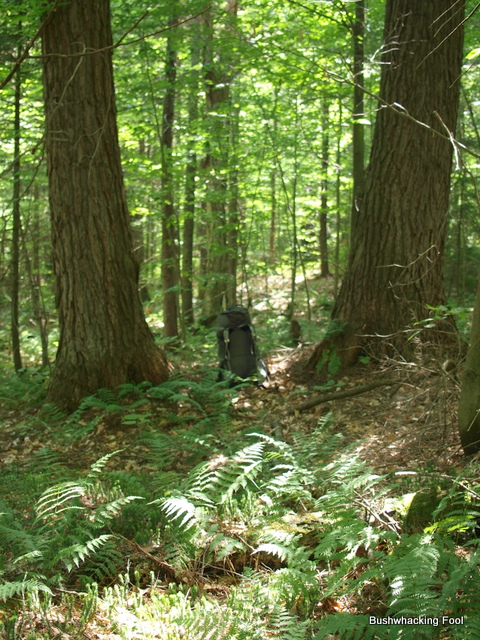
Backpack between large hemlocks
It does not take too long to navigate around to the northern shore of West Pond. Most of the terrain immediately near the shoreline is a steep slope of spruce and fir so I maintain a good distance from the pond where the forest is partially hardwood and less aggressive. When I start getting close to where I believe the rocks should be located, I move in toward the shoreline so as not to overshoot and have to backtrack.
The rocks along the northern shoreline are at the bottom of the steep slope of spruce and fir. Downed conifers lie crisscrossing each other under a sparse canopy of standing conifers on the slope. Given the lack of anything even remotely resembling a level area, it is not a very hospitable area for a campsite, unfortunately.
After a brief search of the area, I find an adequate potential campsite location on the opposite side of the slope rising up from the pond’s shoreline. It is situated in a grove of large eastern hemlocks, next to a giant hemlock log lying on the forest floor. Whether it succumbed to wind or disease, it is impossible to tell.
I spend the majority of the rest of the afternoon down on the rocks. They are not connected to the shoreline but only require a short hop to reach them. Because of the hop and the surrounding tree branches it is impossible to reach the rocks in a stealthy manner.
Once out on the rocks I observe five adult-sized common goldeneyes out on the pond, accompanied by three smaller individuals. It appears they must be engaged in some communal care arrangement for the younger ones.
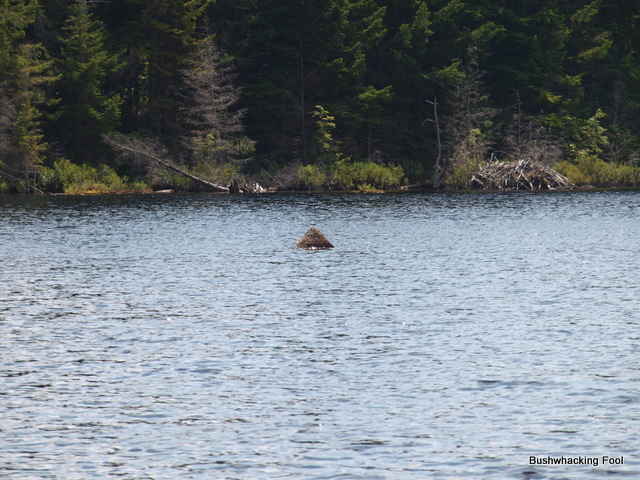
Shark fin-like rock at West Pond
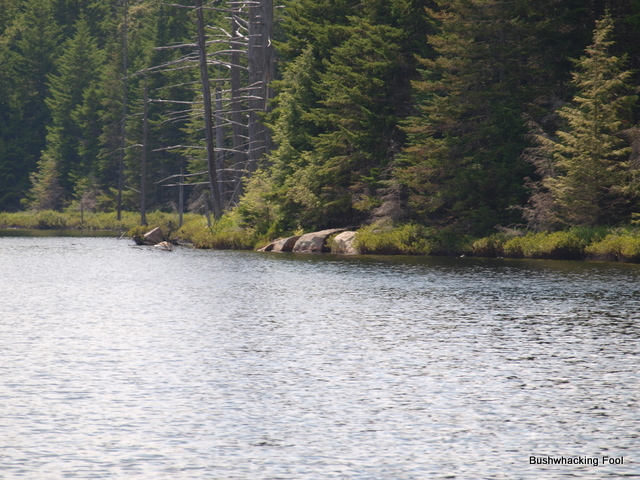
Rocks along northern shore of West Pond
While I am busy getting my Leica binoculars off my hipbelt, a group of five hooded mergansers startle me as they take flight from the western portion of the pond. They fly around the pond several times before disappearing over the forest canopy to the east, apparently heading toward Gal Pond.
A large gang of whirligig beetles swim in circles near the edge of the rock. I swat a deer fly and throw it into the middle of the mob of beetles. Two beetles fight over the tasty morsel, one chasing the other for a time before the roles are reversed and the pursued becomes the pursuer. At one point where one is chasing the other away, a third beetles moves in and snags the dead fly. The two other beetles rapidly swim after this interloper, seemingly teaming up in their pursuit. I chuckle out loud; amused by their Keystone cops-like behavior.
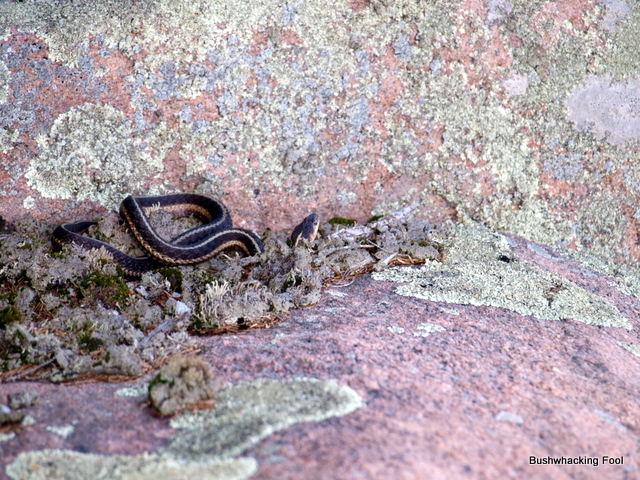
Garter Snake on rock
While taking photographs of the attractive pond, I spot a large garter snake lying on the surface of an adjacent rock. I did not notice it when I jumped out onto the rocks, so I do not know whether it crawled out there while I was taking photographs or it was already there and I simply overlooked it. I would be curious to know how it got out on the rock though.
The snake has its head up in the air as if it smelled something interesting. Then its head starts to rock back and forth, over and over again as if it were attempting to hypnotize me. What is with this behavior? Is it trying to locate some prey? And could that prey possibly be me?!?
When I glance over to check on the snake after being preoccupied with my camera
After the wildlife antics near the pond, I return to my campsite to make dinner. While eating, I get to watch a pileated woodpecker tear apart an old snag just beyond where I set up my tarp. I have never been able to watch one for this long before and I stay as still as possible so as not to disturb it. After many minutes the woodpecker finally flies off through the forest never to be seen again.
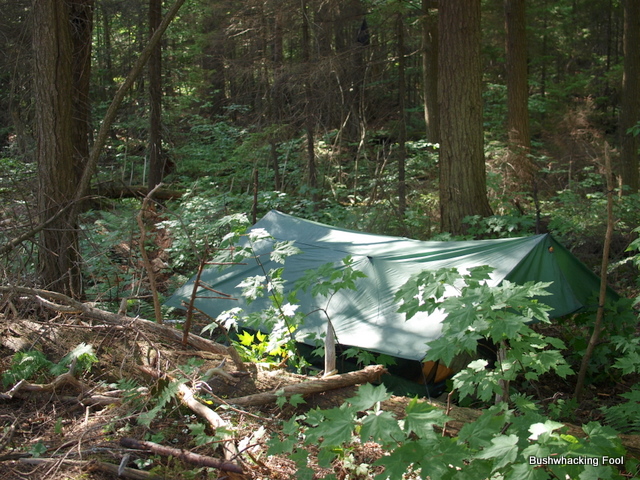
Golite Cave tarp at West Pond
While rehanging my food bag, I notice an old pile of moose droppings. Unlike most of the other piles I observed during this trip, this one has been here for a long time. Obviously, this moose had been in this area a while ago. Where is he now, I wonder? Why are they avoiding me? Do they dislike me that much?
After dinner I return to the rocks for the remainder of the evening. Bullfrogs, as well as mink and green frogs are calling, while mosquitoes and a few black flies buzz around my head. The sky is mostly clear now and an occasional gust of wind scatters the biting insects, giving me a much appreciated few moments of relief.
A beaver lodge lies in disrepair along the southern shore of the pond. Using my binoculars, I can see the lodge looks decrepit and in a state of disrepair. With the water levels down (compared to the water stains on the rocks) and the lodge in its present condition, I reckon the pond must be abandoned by beavers.
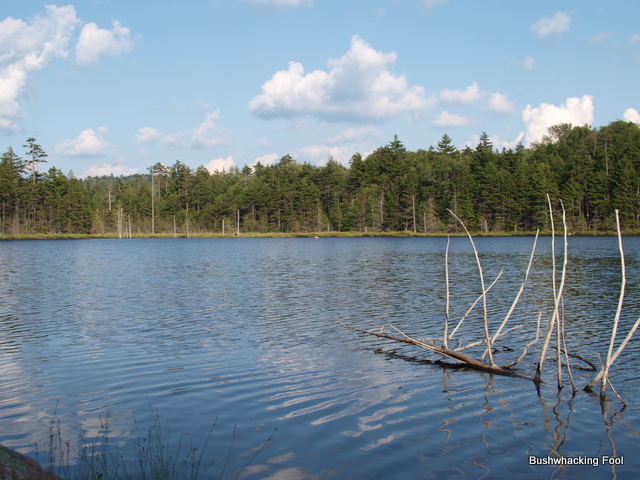
View of West Pond to the east
When I swat at a mosquito biting me on the neck, I am startled by a loud splash, followed by a cacophony of quacking. To my surprise three young hooded mergansers frantically swim from near the rocks behind me out into the water. They do not even slow down until they are almost to the southern shore. The sudden noise leaves me with the hairs on the back of my neck standing on edge for a few minutes. I wonder where their mother is now?
While watching the young mergansers disappear along the southern shore, a large raptor flies over the pond from almost the same identical location. The broad-winged hawk lands in a snag just down the shore from me to the west.
Dangling out of the beak of the hawk is a frog leg, evidently caught along the southern shore. The hawk watches me for a moment and then quickly and silently disappears into the forest. Looks like the hawk chicks are going to have fresh frog legs tonight. Within several minutes the hawk returns and flies across the pond back towards where it originally came from.
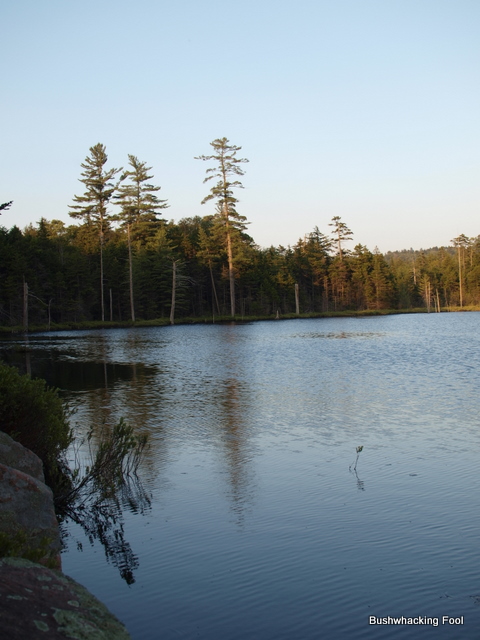
West Pond at dusk
As the sun moves steadily down behind the forest canopy to the west, the mosquitoes started coming out in full force. I stay out on the rock until about nine o’clock watching for the emerging stars and with the hope of observing a single bat. Unfortunately, no bats ever appear as the white-nose syndrome has decimiated many bat species in the Adirondacks. With the mosquitoes swarming around my head, I can wait no longer and I retreat to my tarp for the night.
Tomorrow will be one of the longest days of the trip, as I must descend over a shoulder of Greenfield Mountain to the north, cross the Robinson River, follow the river west until it turns south, hike through uninterrupted forest with an unknown amount of blowdowns back to the trail system and finally hike the trails southwest to Wolf Pond.
As I lie in my sleeping bag, a cacophony of evening sounds surrounds me. A hermit thrush sings nearby. Deer flies trapped under my tarp, buzz as they repeatedly bounce off the nylon (not for those prone to fits of terror when exposed to buzzing insects). Spring peepers and other frogs call nearby and down at the pond’s shoreline. (NOTE: the buzzing in the background of these recordings is NOT distortion but just a run-of-the-mill Adirondack mosquito swarm.)
Together these sounds put me to sleep as I think of the long and arduous day awaiting me tomorrow morning.
Affiliate Disclaimer: Some links within this blog post may send you to a retailer website. If you chose to purchase any product at that site at that time the author will receive a small commission. These commissions provide compensation for the author’s time and effort necessary to provide the amazing content at the Bushwhacking Fool.


Adirondack Bank Beaver
November 15, 2011 at 10:10 am
How do you rate your hikes? A moderate to you might be a difficult for other people. I have not seen any of your adventures rated as being difficult. Why is that? Is there just not enough challenging regions of the Adirondacks for you or are you just a super -human bushwhacker?